Projects Robotics Live product

DecentraliDrones

A decentralised autonomous drone delivery system, trained in simulation with reinforcement learning.

Open the simulator (Source)

Free to open · no account · nothing to upload

Drones
Dispatchers
Real footprints
Trained weights

The problem

Delivery drone research usually assumes a central controller. That is convenient and unrealistic: it makes the coordinator a single point of failure and does not scale with fleet size.

What it does

Agents are trained with TD3 inside AirSim on an Unreal Engine environment, and coordinate without a central authority. Navigation, obstacle handling and route decisions are learned in simulation rather than scripted.

The part that mattered

Simulation fidelity. A policy that only works in the simulator it was trained in has learned the simulator, not the task — so environment variation mattered more than reward tuning.
(01)

Nobody is at the controls, and that is the point

An order is not handed to a drone. It is broadcast, and the idle pairs answer with a bid — how far away they are, what they are carrying, how much battery is left. Every drone works out the winner for itself from the same bids, so there is no control room to take down and no queue to jam.

They fly in pairs: one carries the parcel, the other flies behind and above it, watching the side the carrier cannot see. Every few seconds each drone tells the others where it is and what it holds, and each keeps its own copy of that picture. Select a drone in the simulator and you see the swarm as that one drone believes it to be, stale corners and all.

Figure 2 of the paper, as a running system
  1. InAn orderaddress · payload
  2. Step 1Markera unique printed code
  3. Step 2Bididle pairs · no desk
  4. Step 3Flycarrier + wingman
  5. Step 4Findlower · match the code
  6. Step 5Landrelease on the marker
  7. OutDeliveredor returned, and why

(02)

A real neighbourhood, not a test box

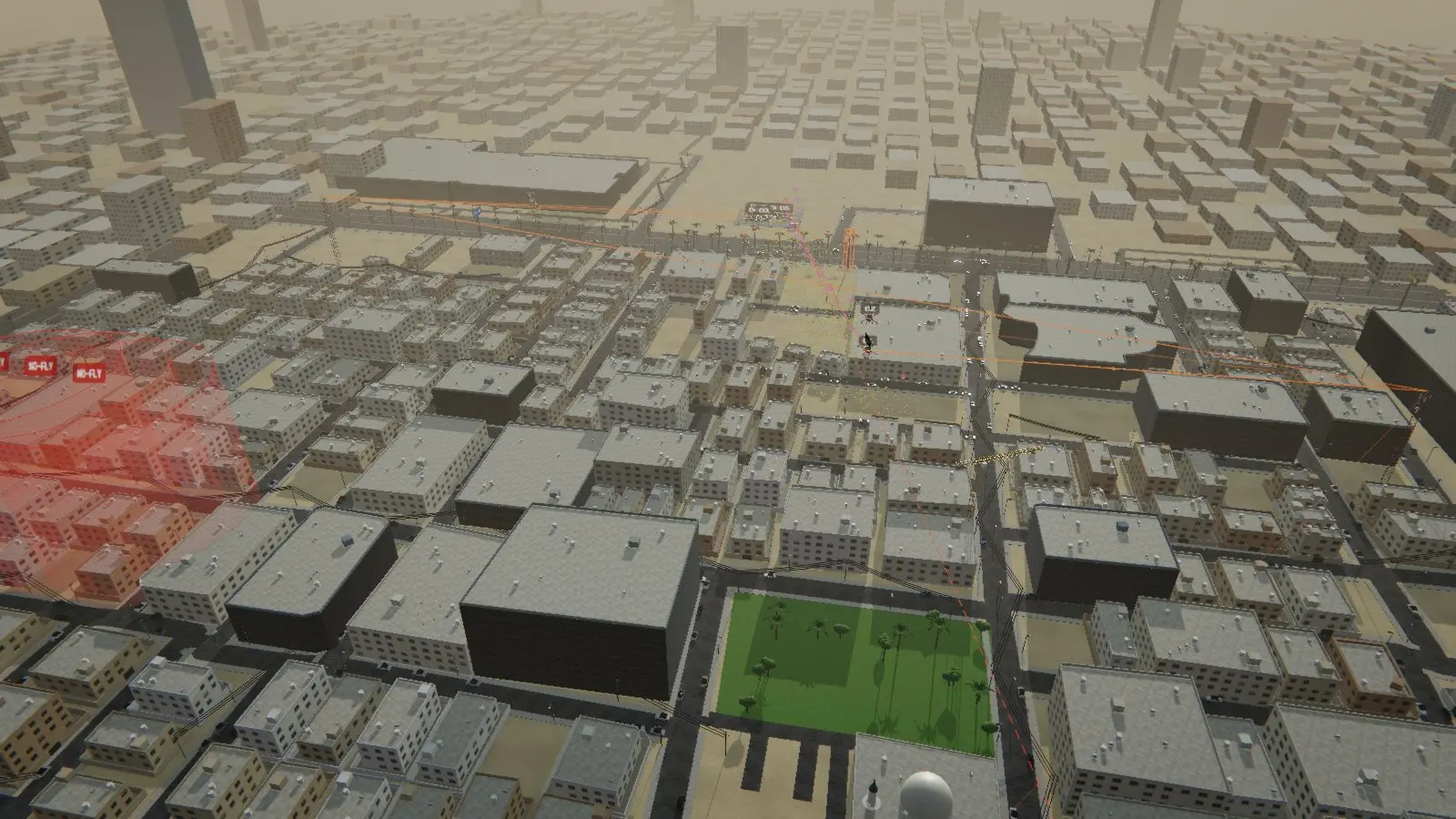
The district is Al Wurud in Riyadh, built from 615 real building footprints and 147 named streets. Click any roof and the swarm will deliver to it. Kingdom Centre and Al Faisaliah stand on the skyline at their true bearing, because a pilot’s-eye view with the landmarks in the wrong place is a cartoon.

A street map knows buildings. It does not know the lamp posts, the power lines, the palms, the tower cranes or the minaret — so those are in the world and not in the map, and the drones have to see them for themselves. What they find, they mark, and they tell each other.

The district, mid-delivery: routes flown, corridors mapped, airspace kept out of
The simulator over Al Wurud: the city in 3D with flight routes drawn between roofs and no-fly cylinders standing over the embassies.
The district

(03)

Ride along, and read the radio

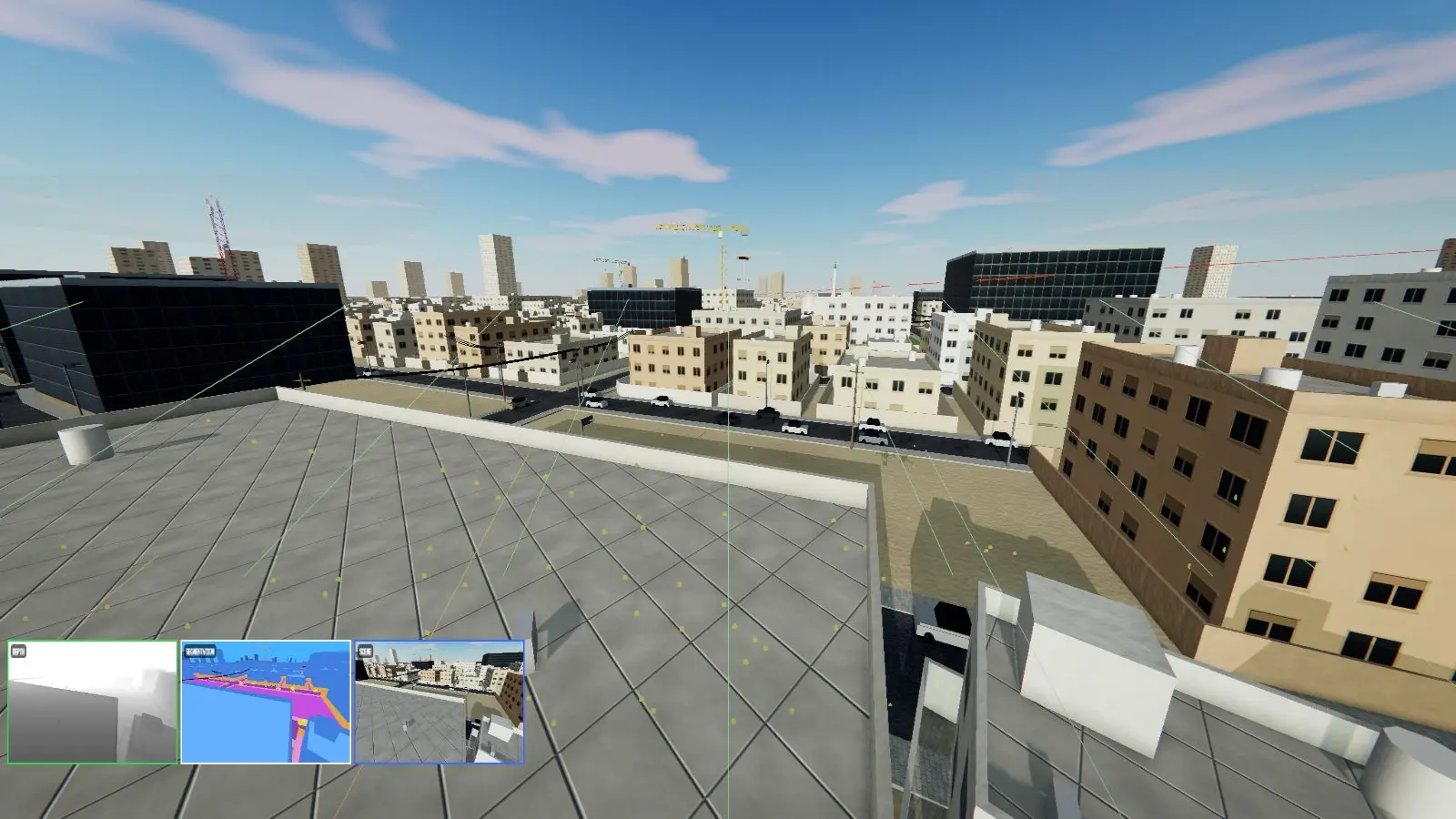
Any drone can be ridden. Sit in its camera, look down at the landing marker, or watch it from its partner’s point of view. Three small screens come with it — the depth camera, the segmentation view and the scene camera — which are the three views the research ran on.

Beside them the messages scroll: the bid it made, the handshake with its wingman, the check-in it broadcast, which cell tower each hop went through and how long it took. Take the towers down and the drones start passing messages to each other instead, hop by hop, and the log shows that too.

On board: the depth, segmentation and scene cameras the trained network flies on
The view from a drone’s own camera, with the depth, segmentation and scene insets along the bottom of the frame.
From the cockpit
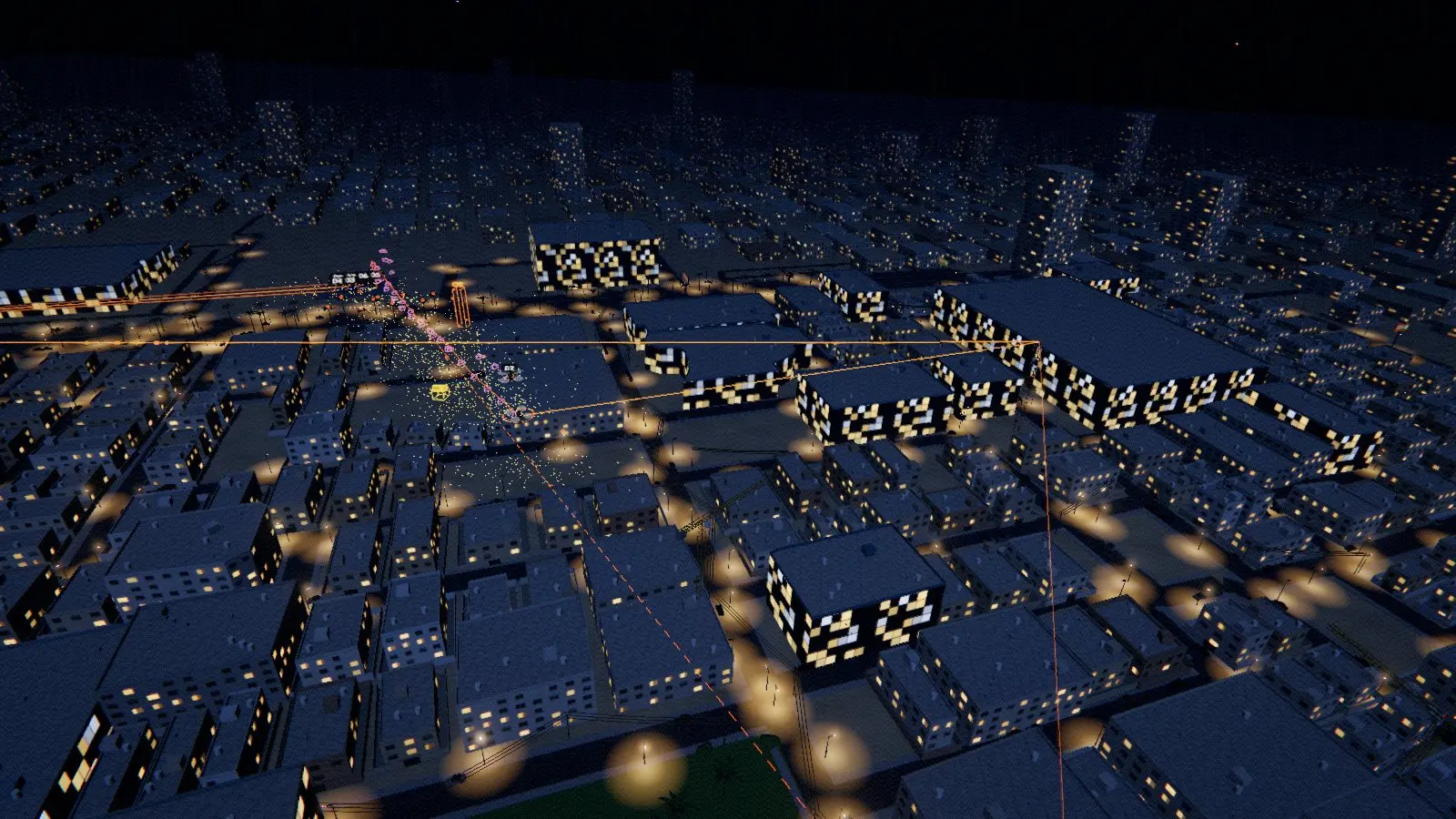
The same district after dark: street lamps on, a pair’s navigation lights crossing the rooftops.
Any hour of the day

(04)

Four ways not to hit things, and a referee

The paper’s answer to avoidance is not one algorithm but four, with a framework that picks between them by what the drone is looking at. Measured on delivery accuracy, efficiency and collision avoidance, the framework beats each of its parts — which is the whole argument of the paper, and it is drawn here rather than described.

The default is a reinforcement-learning agent trained with prioritised replay. The weights flying in your browser are the real ones from the project’s training runs — 65,773 of them, read frame by frame off the depth camera of whichever drone you are following. Over its last three hundred training episodes that agent finished the course 42% of the time, the best of the agents whose logs record outcomes.

Table 4 — each method, and the framework that switches between them
Proximity avoidance
Dynamic path planning
Visual-SLAM
The framework

Delivery accuracy, as the paper reported it — the framework is the top row

(05)

Try to break it

A delivery system is only interesting when something goes wrong, so the failures are buttons. Knock a drone out of the sky: it broadcasts where it is going down and what it was holding, and the others hold an auction for the parcel. No marker on the roof: the carrier asks, hovers on a timer, then comes home and says why.

Switch every cell tower off and watch the mesh take over. None of this is scripted — the same protocol that runs the good case runs the bad one, which is the only way to find out whether it holds.

The swarm: four pairs, one carrying, one covering, and one about to take over

It started as a paper

DecentraliDrone: A decentralized, fully autonomous drone delivery system for reliable, efficient transport of goods

Alexandria Engineering Journal, 88, 1–30 2024

Read the paper’s page

Questions we get asked

Is this a video, or is it running?
It is running. The city is drawn on your own graphics card, the swarm’s messages are passed one by one, and the neural network flies on a depth image rendered live. It adjusts its own quality to the machine it finds itself on.
Are the drones really deciding?
There is no dispatcher in the code. Orders are broadcast, pairs bid, and each drone resolves the winner from the bids it heard. That is also why a tower blackout degrades it rather than stopping it.
Could this fly for us?
The path there starts with a digital twin of your own district — your streets, roofs, no-fly zones and airframes — to plan yards and test routes before anything leaves the ground. Pharmacies, campuses, compounds and islands are where it makes the most sense.

Riyadh, Saudi Arabia

Open it yourself.

The demo is free, and everything it needs is already inside it. When you want it on your own ground — your data, your people, your rules — that is a conversation and a number in writing, not a licence you click through.

Open the simulator (Talk to us about it)

The other two products

Other Projects

Built With Care And A Lot Of Code

WhatsApp