Projects Computer Vision Live product

AutoEx

Automated grading of handwritten answer sheets, combining computer vision, language processing and machine learning.

Open the examiner (Source)

Free to open · no account · nothing to upload

Stages
Exams in the demo
Word error rate
To sign up

The problem

Marking handwritten exam scripts is slow, repetitive and inconsistent between markers. The interesting difficulty is not reading the handwriting — it is deciding whether an answer is correct when it is phrased differently from the model answer.

What it does

The pipeline segments scanned answer sheets, recognises the handwriting, and scores each response against a reference using language models rather than string matching. Vision handles extraction; language handles judgement.

The part that mattered

Separating those two stages. Recognition errors and grading errors have different causes and different fixes, and keeping them apart makes both measurable.
(01)

The paper, turned into a door you can open

The research described five stages: segment the page, read the handwriting, correct what was read, match it against the examiner’s keywords, and report on the class. It ran on a laptop, in R, for one person.

The product keeps all five and moves them to where a school actually is. The segmenter runs inside the browser, the reader is a vision model, the mark book is a web page, and the whole thing opens from a link with no account and nothing to install.

Figure 2 of the paper, as a running system
  1. InPhoto of a pagephone · scanner
  2. Stage 1SegmentOtsu · dilate · contours
  3. Stage 2Readvision model · Tesseract
  4. Stage 3Correctstem · edit distance
  5. Stage 4Matchkeywords × weights
  6. Stage 5Reportmean · spread · grades
  7. OutMarks + CSVinto the mark book

(02)

Nine exams are already inside it

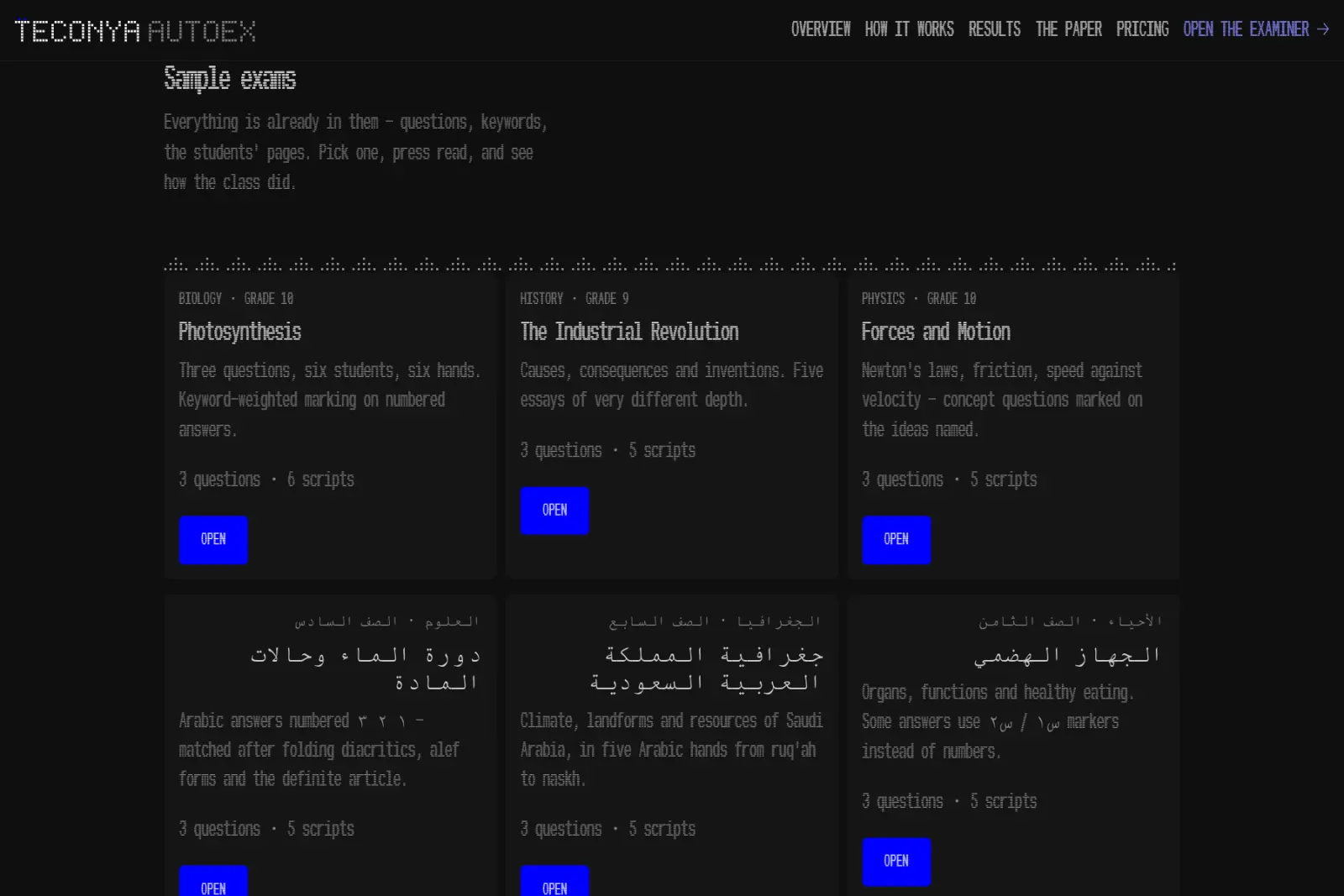
Nobody arriving at a demo has a stack of marked scripts to hand, so the examiner comes with its own: nine exams across English, Arabic and mathematics, with the questions, the keywords and twenty-five handwritten pages in as many hands already loaded. There is nothing to upload and nothing to invent.

Right-to-left pages are read as they were written, with diacritics, alef forms and the definite article folded before matching. Equations earn their marks in parts — the formula, the substitution and the answer are matched separately.

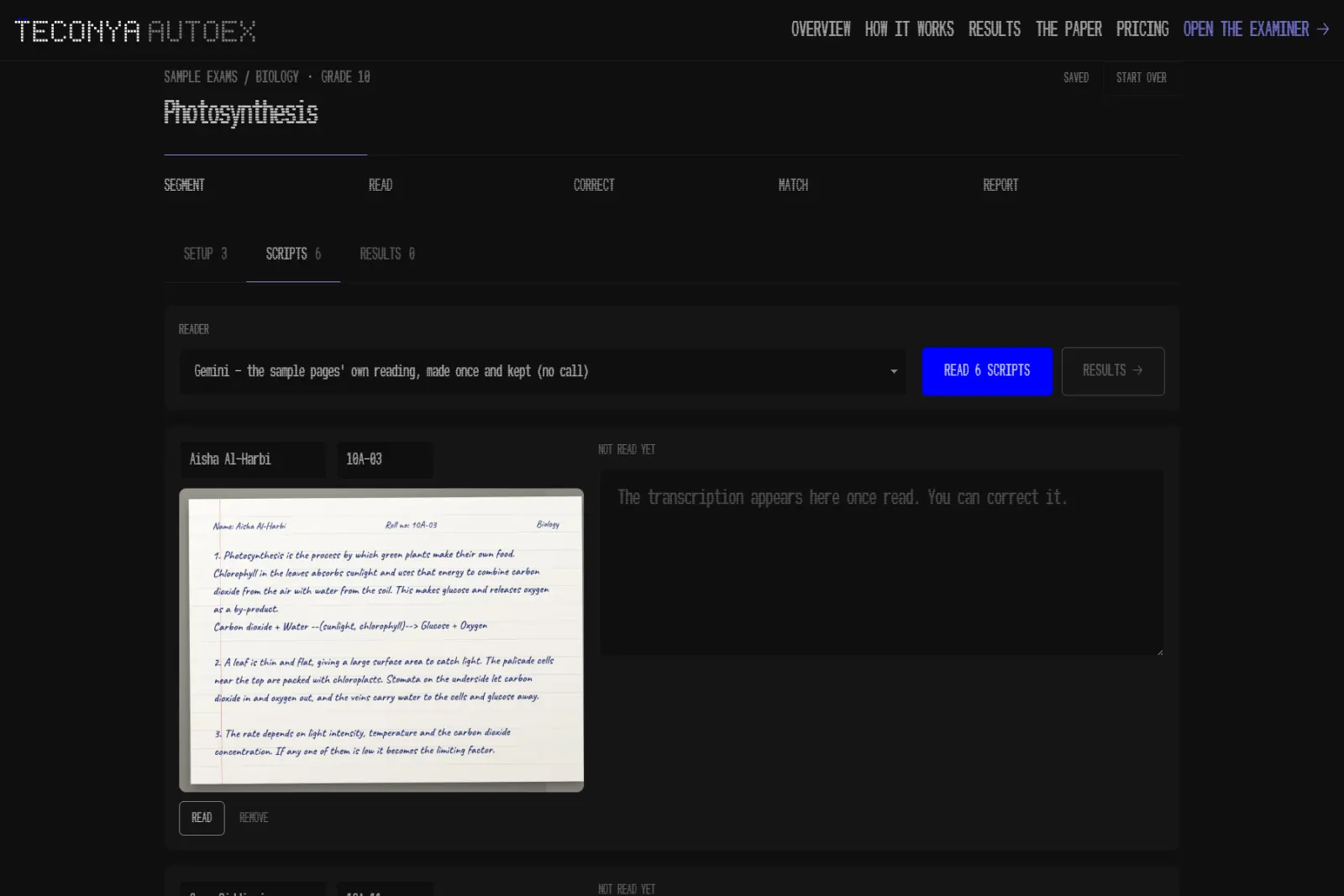
The examiner: the exams it ships with, and one script waiting to be read
The examiner’s list of sample exams: biology, history, physics and mathematics in English, three papers in Arabic.
Nine exams, ready
One exam open: the five stages across the top, a handwritten biology script on the left, its transcription waiting on the right.
A script, before the read

(03)

Every mark says where it came from

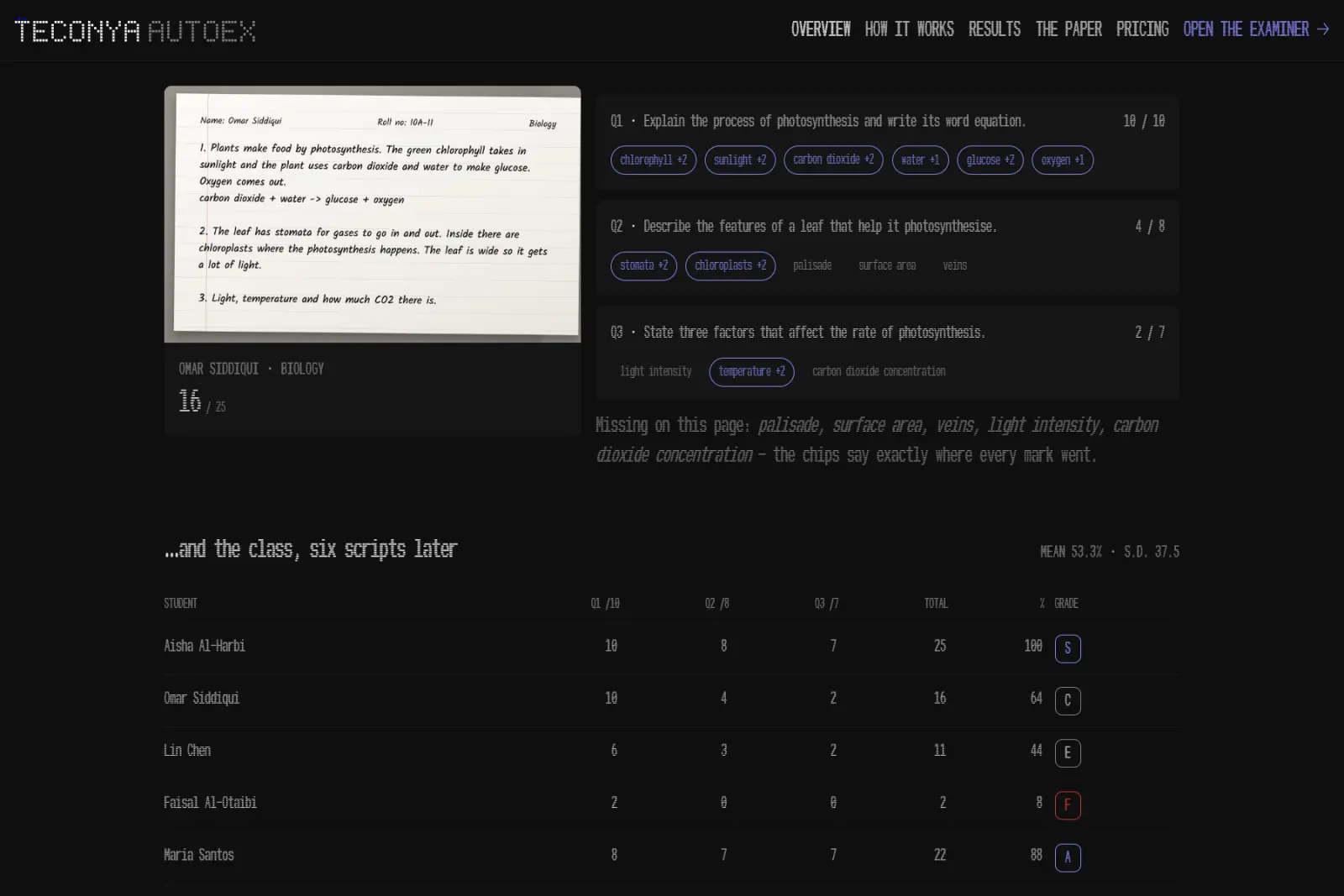
A mark with no explanation is a mark that cannot be appealed. Each question lists the keywords the student actually wrote, the ones they missed, and how each one matched — exactly, by stem, or fuzzily within an edit or two, so a misspelling still earns its mark.

Change a keyword or a weight and the whole class re-scores in front of you. Marks are capped at each question’s maximum, and the transcription stays editable, because a reader that cannot be corrected is a reader nobody will trust.

One script, marked — every keyword found, and every one missed
A marked script: each question with its score out of the maximum and chips for every keyword found or missed.
The evidence for a mark

(04)

Then the class, in one page

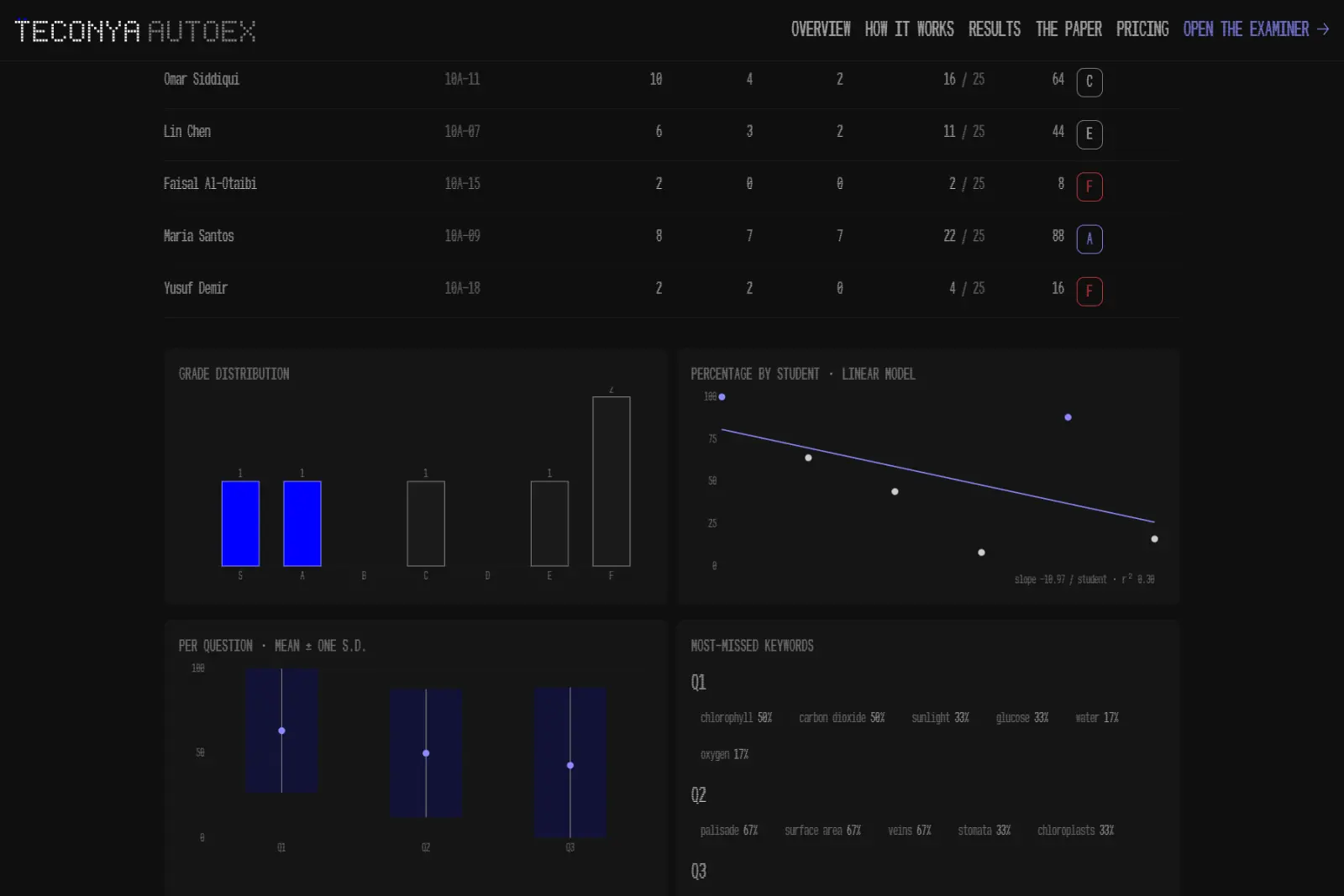
Marking one script is a party trick. The useful part comes after the sixth: the mean and the spread, grades on fixed bands or the class’s own quartiles, a line through the scores, and the concepts the class missed most — which is the part that changes what gets taught on Sunday.

On the six sample scripts the class averages 53.3% with a standard deviation of 37.5, and the three questions separate cleanly. One click exports the whole mark sheet as CSV.

The sample class: the mark sheet, the mean per question, and where the grades fell
The class mark sheet: every student’s marks per question, their grade, the grade distribution, a line through the scores and the keywords the class missed most.
Six scripts, one page
Q1 · mean
Q2 · mean
Q3 · mean
Class
  • S1
  • A1
  • B0
  • C1
  • D0
  • E1
  • F2

(05)

How wrong the reader gets it, said plainly

The paper evaluated the reader and reported a word error rate of 5.6%. That is about fourteen words in every two hundred and fifty — enough that a human still signs off the marks, and few enough that the signing-off is a review rather than a re-marking.

Where a page may not leave the building at all, the reader can be swapped for one that runs on the device itself. It is less accurate on cursive, and it never sends a thing.

Two hundred and fifty words read; the struck cells are the ones it got wrong

It started as a paper

Design of automated model for inspecting and evaluating handwritten answer scripts: A pedagogical approach with NLP and deep learning

Alexandria Engineering Journal, 108, 764–788 2024

Read the paper’s page

Questions we get asked

Is the demo really free?
Yes. There is no account, no card and nothing to upload — the sample exams and scripts are already in it. For an institution we set it up as a system on your ground and price it for your size, not by the page.
Does a student’s paper leave our building?
Only the page you choose to read, and only to the reader you choose. Exams, scripts and marks live in your own browser’s storage; for scripts that must not leave at all, the on-device reader keeps them there.
Can it mark Arabic?
Yes, and three of the sample exams are Arabic. Pages are read right to left, and diacritics, alef forms and the definite article are folded before the keywords are matched.

Riyadh, Saudi Arabia

Open it yourself.

The demo is free, and everything it needs is already inside it. When you want it on your own ground — your data, your people, your rules — that is a conversation and a number in writing, not a licence you click through.

Open the examiner (Talk to us about it)

The other two products

Other Projects

Built With Care And A Lot Of Code

WhatsApp